A common mistake in the Tairāwhiti region is treating all foundation ground the same. Gisborne’s coastal terraces and river floodplains hide loose, saturated sands that can settle instantly under load or liquefy during a quake. A standard footing pad won’t cut it here. We step in with vibrocompaction design that maps out the treatment grid, probe spacing, and energy input needed to densify these weak zones before concrete ever touches the ground. For contractors working near the Taruheru River or out toward Wainui Beach, the difference between a guess and a design backed by CPT data is a structure that stays level. We combine in-situ CPT testing to map the loose layers, then correlate with grain-size analysis to confirm the soil will respond to vibratory densification.
A well-designed vibrocompaction grid in Gisborne alluvial sands routinely achieves relative densities above 70%, cutting post-construction settlement to under 25 mm.
Technical details of the service in Gisborne
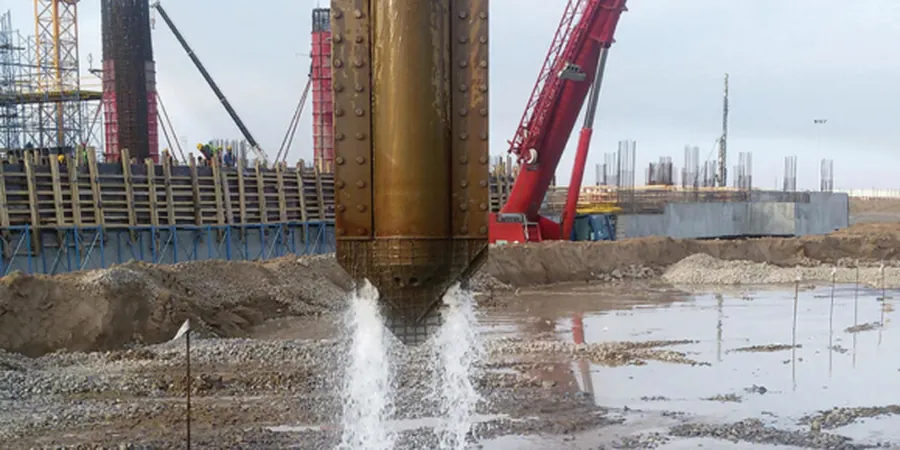
Local geotechnical conditions in Gisborne
Gisborne’s urban expansion onto the Poverty Bay flats has placed dozens of light industrial and retail buildings on soils mapped as liquefaction-prone in the Gisborne District Council hazard models. The 2007 Gisborne earthquake, while centred offshore, was a wake-up call: loose sands across the flats amplified shaking and caused localised ground cracking. A vibrocompaction design that ignores the fines content or the groundwater table depth—typically sitting at just 1.5 to 2.5 m below the surface in winter—creates a false sense of security. The risk is not just total settlement; it is differential movement that tears tilt-slab panels apart. We design treatment programs that extend at least 2 m beyond the building footprint and specify post-treatment verification with CPT soundings at 10% of probe locations, as recommended by NZGS Module 5. No compaction design leaves our office without a clear pass/fail criterion.
Our services
Our vibrocompaction design package for Gisborne sites covers every phase from desktop assessment to field sign-off. Each deliverable is tied to a specific NZ standard or accepted international practice.
Pre-Treatment Site Characterisation
We review existing borelogs and run supplementary CPT soundings to define the loose layer geometry, groundwater level, and fines content before designing the grid.
Vibrocompaction Grid Design & Specifications
We deliver a stamped design package with probe spacing, depth, energy input, backfill gradation requirements, and treatment sequence for your drilling contractor.
Field Quality Control & Monitoring
Our engineers supervise the trial zone, log real-time amperage and penetration data, and adjust the design if ground conditions deviate from the model.
Post-Treatment Verification Testing
We conduct CPT soundings and sand-cone density tests at specified grid points, comparing results against the NZS 3404 target density to close out the ground improvement scope.
Frequently asked questions
What is the typical cost range for a vibrocompaction design package in Gisborne?
For a standard commercial site in the Gisborne area requiring a design package with pre- and post-treatment CPT verification, fees range between NZ$2,530 and NZ$7,740. The spread depends on the treated footprint size, number of probe points, and depth of the loose layer. A larger industrial shed near the Waipaoa River will push toward the upper end due to deeper treatment and more verification soundings.
How deep can vibrocompaction effectively densify the sandy soils found in Gisborne?
With the electric vibroflots we specify, effective densification reaches 12 to 15 m below ground level in the clean sands typical of the Poverty Bay flats. Beyond 15 m, or when silt content exceeds 15%, we typically recommend a combined approach with stone columns for the deeper layer.
What verification do you require to sign off on a vibrocompaction job?
We require CPT soundings at a minimum of 10% of the treatment points, distributed across the grid. Each sounding must show a tip resistance above the project-specific threshold—commonly 12 MPa in Gisborne sands—and a friction ratio consistent with densified granular material. We also correlate with a limited number of sand cone density tests to confirm the CPT interpretation.