Working across the Poverty Bay flats and the hill suburbs above the Waimata, our team regularly encounters the sharp contrast between the deep alluvial sediments of the floodplain and the softer Miocene siltstones that mantle the steeper terrain. Gisborne sits in one of New Zealand’s most seismically active regions — the Hikurangi subduction interface lies just offshore and the city has recorded over 15,000 shakes since 2010, including the 2007 M6.8 event that triggered widespread lateral spreading near the port. A desktop site classification is rarely enough when the geology changes inside a single city block. Seismic microzonation becomes the framework that connects NZS 1170.5 site subsoil classes with measured shear-wave velocity profiles, while a parallel liquefaction assessment quantifies the cyclic resistance of the loose pumiceous sands deposited by the Waipaoa River over the past 6,500 years.
A reliable microzonation map in Gisborne needs at least one Vs measurement per 2,500 square metres — anything coarser misses the buried paleochannels that control amplification.
Technical details of the service in Gisborne
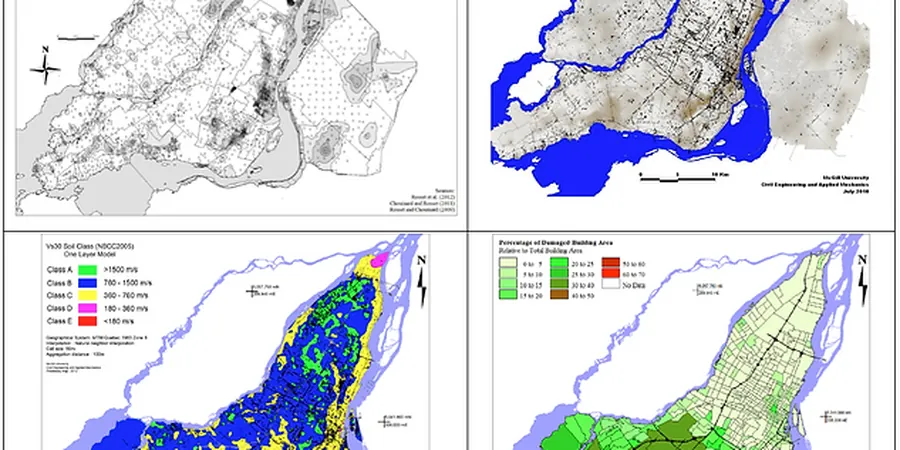
Local geotechnical conditions in Gisborne
The Hikurangi subduction margin generates two distinct hazard types that a proper Gisborne microzonation must address: shallow crustal earthquakes on the Gable End and Waimana faults, which produce high-frequency shaking most damaging to low-rise structures, and deep intraslab events or slow-slip episodes on the plate interface that deliver long-period energy amplified by the thick sedimentary basin. The 1947 Poverty Bay tsunamigenic earthquake showed how quickly ground failure can cascade — liquefaction-induced lateral spreading severed the railway embankment near Awapuni while slope failures closed the coast road north of Tatapouri. Our maps integrate the NZGS liquefaction severity number (LSN) with topographic amplification factors derived from LiDAR so that planners can identify corridors where essential facilities should be avoided or where foundation upgrades become mandatory. Ignoring basin-edge effects in the Kaiti and Elgin areas leads to underestimating spectral ordinates by 30–50%, a gap that standard site classification alone cannot close.
Our services
A seismic microzonation study in Gisborne generates a layered set of deliverables that move from broad geophysical mapping to site-specific engineering parameters. The two core service blocks below cover the full workflow from field acquisition to design-ready ground-motion spectra.
Vs30 mapping and site classification
We deploy active and passive surface-wave arrays (MASW and ReMi) on grids tailored to the parcel geometry, calibrated with downhole seismic or seismic CPT soundings. The output is a continuous Vs30 contour map with NZS 1170.5 site classes assigned to each microzone, plus amplification factors Fa and Fv for limit state design.
Liquefaction hazard microzonation
Combining CPT tip resistance, grain-size data from sonic cores, and groundwater monitoring, we calculate the Liquefaction Potential Index (LPI) and Liquefaction Severity Number (LSN) on a grid basis. The maps show vertical settlement and lateral spread displacement estimates under the 25-year, 100-year, and 500-year return-period motions required by the Gisborne District Plan.
Frequently asked questions
What is the approximate cost of a seismic microzonation study for a typical subdivision in Gisborne?
Microzonation budgets range from NZ$7,690 for a small infill site requiring a basic Vs30 survey with eight to ten MASW arrays up to NZ$31,100 for a multi-hectare greenfield subdivision involving 30+ measurement points, downhole calibration, CPT-based liquefaction mapping, and a full NZGS Module 3 report. The main cost drivers are the required grid density, depth to bedrock, and whether the council requests a peer review by an independent geotechnical specialist.
How does microzonation differ from a standard site investigation?
A standard borehole or CPT investigation classifies the soil column at a single point, while microzonation maps the spatial variation of dynamic soil properties across an entire site. Our work in Gisborne uses surface-wave geophysics to capture the lateral continuity of soft layers, paleochannels, and basin-edge geometry that point data inevitably misses, then converts that into design spectra for each identified zone.
Which Gisborne areas require microzonation under the current district plan?
The Gisborne District Council generally triggers microzonation for subdivisions of more than ten lots, essential facilities (fire stations, emergency centres), and structures with an importance level of 3 or higher. The Poverty Bay flats from Kaiti to Awapuni are flagged due to liquefaction-prone Holocene sediments, while the hill suburbs require site-specific amplification studies where the slope exceeds 15 degrees or where fill platforms are proposed.
How long does a full microzonation study take from fieldwork to final report?
Fieldwork typically takes two to four weeks depending on the site area and access constraints. Processing the surface-wave data, building the Vs30 model, and running the site-response analyses requires another three to five weeks in the office. The final report, with maps and design spectra, is usually delivered within eight weeks of mobilisation.