Gisborne’s CBD and riverside suburbs sit on deep alluvial deposits of the Waipaoa and Taruheru floodplains, where groundwater often appears less than 2 m below the surface. Any excavation deeper than a single basement level triggers NZS 3404 requirements for retaining wall design, strutting, and dewatering. The 2007 Gisborne earthquake, a shallow M6.8 event, proved that even moderate shaking can cause lateral spread and base heave in saturated silts. Our geotechnical design of deep excavations starts with a site-specific ground model built from CPT and laboratory triaxial data, not generic assumptions. We size shoring systems, check basal stability against blowout, and specify depressurisation measures that keep the cut dry and the adjoining streets stable. For projects near the Taruheru River, we integrate a liquefaction assessment to verify that passive resistance won’t degrade during shaking.
Base stability in Gisborne’s soft alluvium depends more on groundwater control than on wall stiffness—get the dewatering right and the numbers fall into place.
Technical details of the service in Gisborne
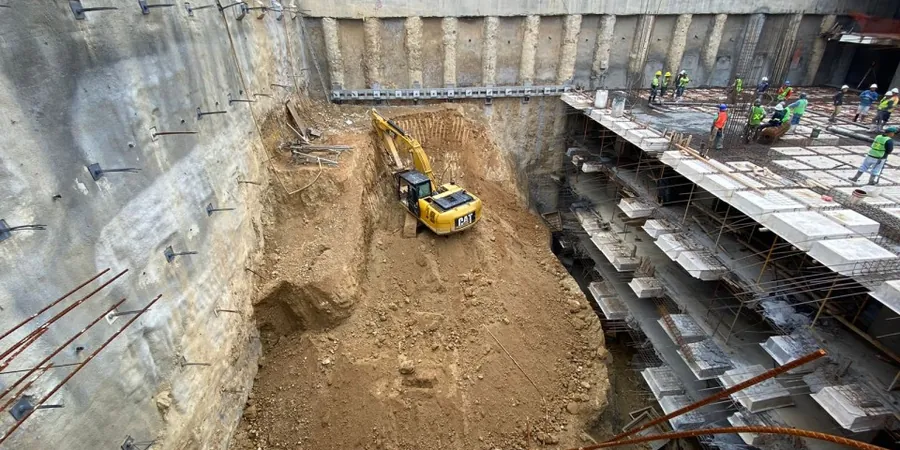
Local geotechnical conditions in Gisborne
On a recent cut-and-cover excavation near the Taruheru River, the contractor installed a 10 m deep sheet pile wall with a single-level strut system. Groundwater was drawn down to formation level using vacuum-assisted wellpoints spaced at 1.8 m centres. The main risk wasn’t wall bending—it was piping at the toe. Our geotechnical design of deep excavations added a 1.5 m thick submerged filter berm and specified a pore pressure trigger for the piezometers. When one piezometer spiked during a week of heavy rain, the contractor paused excavation for 48 hours and increased the dewatering flow rate. No base instability occurred. The lesson: in Gisborne’s alluvial ground, hydrostatic pressure is the controlling load case, and the design must give the site team clear hold points linked to real-time monitoring data.
Our services
Our geotechnical design of deep excavations covers the full spectrum from feasibility to construction support. Every project follows the NZGS observation-based approach.
Shoring & Retaining Wall Design
Contiguous and secant pile walls, soldier beam with shotcrete. Dimensions, reinforcement schedules, and construction sequence drawings compliant with NZS 3404.
Dewatering & Groundwater Control
Wellpoint, ejector, and deep well system design. Flow rate calculations based on in-situ permeability tests. Discharge and settlement impact assessment.
Basal Stability & Heave Analysis
Limit equilibrium checks for hydraulic heave and bearing failure. FEM-modelled base uplift. Berm and jet-grout block design where passive resistance is insufficient.
Construction Monitoring & Peer Review
Inclinometer arrays, standpipe and vibrating-wire piezometers, building settlement markers. Trigger-level reporting aligned with the construction-stage ground model.
Frequently asked questions
How much does deep excavation design cost for a project in Gisborne?
Fees for geotechnical design of deep excavations in Gisborne typically range from NZ$3,960 to NZ$15,300, depending on excavation depth, wall type, groundwater complexity, and the number of construction stages that require analysis. A simple single-basement cut with soldier piles and one strut level sits at the lower end; a multi-level secant pile wall with dewatering simulation and building impact assessment moves toward the upper end. We provide a fixed-scope proposal after reviewing the architectural and structural concept drawings.
What subsurface investigation is needed before deep excavation design?
We require CPT soundings at each wall line and at least one borehole with SPT and undisturbed sampling to cover the excavation depth plus 1.5 times the depth for basal stability. In Gisborne’s alluvial soils, field vane tests and in-situ permeability tests (falling head) are critical. Laboratory triaxial CIU or CAU tests provide the undrained strength for the soft clay layers.
Which wall system is most common in Gisborne’s soils?
Contiguous bored pile walls with shotcrete infill work well where groundwater can be lowered temporarily. Secant pile walls are preferred when the water table is high and adjacent structures are sensitive to settlement—common near Gladstone Road and the port area. Sheet piles are used for shallower cuts but refusal on gravel lenses can be a problem.
How is seismic performance incorporated into the excavation design?
We apply the NZS 1170.5 seismic hazard spectrum for Gisborne (Z=0.3, soil class D or E) to the soil-structure interaction model. The wall is checked for inertial forces from the retained soil and for kinematic loading from the free-field ground motion. Liquefaction-induced loss of passive resistance is assessed using CPT-based triggering methods, and the strut loads are increased where lateral spread is predicted.
What monitoring is standard during a deep excavation in Gisborne?
At minimum: inclinometers in at least two soldier piles or bored piles, standpipe piezometers outside the excavation footprint, and optical survey prisms on adjacent buildings and footpaths. For excavations deeper than 8 m or near the river, we add vibrating-wire piezometers with remote logging. Readings are taken daily during active excavation and compared against pre-set trigger levels.