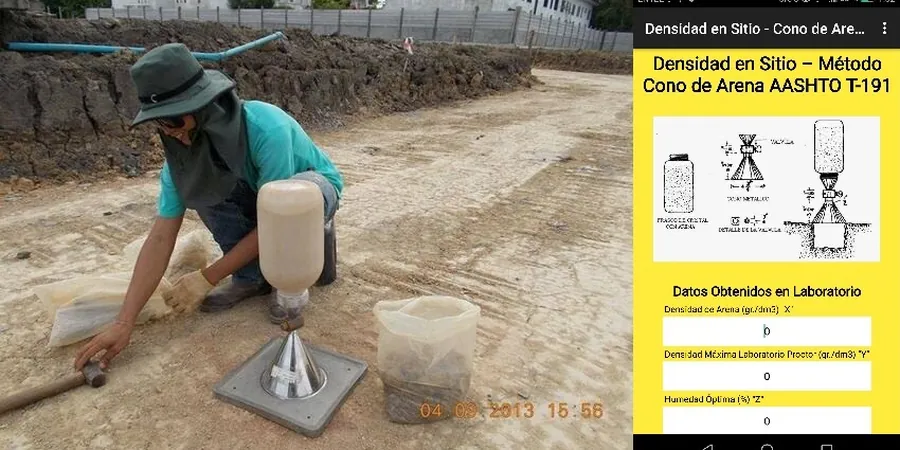
One of the most persistent issues we see on Gisborne sites is premature pavement cracking or fill settlement that traces straight back to inadequate compaction records. Contractors often rely on roller pass counts and visual checks, assuming the underlying silty or pumice-derived soils have achieved spec density. Without a physical density test, those assumptions can prove expensive. The sand cone method remains the most practical and standardised way to verify in-place density on earthworks, trench backfill, and subgrade preparation across the Poverty Bay region. Our team uses calibrated sand, precision cones, and NZS 4402 procedures to give you a defensible result that stands up to council and engineer review — whether you are compacting a building platform in Whataupoko or an orchard access road out towards Manutuke.
A sand cone test measures the one thing that roller passes cannot: the actual in-place dry density against a laboratory standard, right where the material was placed.
Technical details of the service in Gisborne
Local geotechnical conditions in Gisborne
The risk profile for compaction defects changes dramatically between a site in Kaiti and one on the deep alluvial soils out near Matawhero. Kaiti hill sites often sit on weathered papa mudstone or sandstone that breaks down to a clayey silt — material that can look firm but loses strength rapidly when over-compacted on the wet side of optimum. On the Matawhero flats, by contrast, we frequently encounter loose silty layers with high void ratios that require heavier compaction effort and closer test spacing to catch zones of low density before the next lift covers them. What worries us most is when a density test is omitted on trench reinstatement across roadways; the subsequent differential settlement creates a maintenance liability that lasts for years. A CPT test can provide a continuous profile of relative density in deeper fills where sand cone access is limited, offering a useful complementary dataset for the earthworks supervisor.
Our services
Our field density work in Gisborne supports a range of earthworks and infrastructure projects. Each service runs through our IANZ-accredited laboratory to ensure calibration traceability and reporting compliance.
Earthworks compaction control
Layer-by-layer density testing on subdivision fills, building platforms, and commercial site works, with results delivered within 24 hours via our field-to-lab data system.
Roading subgrade and subbase QA
Sand cone testing to verify NZTA M/4 compaction compliance on council roading contracts, including moisture conditioning advice for Gisborne’s variable silt and gravel materials.
Trench and pipe backfill verification
Post-compaction density checks on utility trench reinstatements across carriageways and footpaths, reducing the risk of long-term surface deformation in urban corridors.
Laboratory Proctor reference testing
Standard and modified Proctor compaction curves (NZS 4402) run on project-specific borrow material to establish the target maximum dry density before field sand cone testing begins.
Frequently asked questions
How much does a field density test using the sand cone method cost in Gisborne?
For a standard sand cone density test on a site within the Gisborne urban area, you can expect to pay between NZ$200 and NZ$270 per test. The exact price depends on travel distance to rural sites, the number of tests scheduled in a single visit, and whether parallel moisture content samples need express laboratory processing. We typically provide a lump-sum quote for larger subdivision or roading contracts where multiple lots are tested per day, which brings the per-test cost down significantly.
What soil types in Gisborne are most difficult for compaction verification?
The biggest challenge in this region comes from the pumice-rich silts and the highly plastic alluvial clays found across the Poverty Bay flats. These soils have a narrow moisture window for compaction, and if they are too wet, the sand cone test will show low relative compaction even with high compactive effort. We often recommend a trial compaction strip with moisture conditioning before starting production earthworks on these materials.
How soon after compaction can you test a lift with the sand cone?
The test can be performed as soon as the roller has finished its final pass on the lift and the surface is firm enough to set the base plate without disturbing the compacted material. Unlike nuclear gauge methods, the sand cone method requires no radiation safety clearance or warm-up time. We excavate the hole carefully, collect all the material, and determine density on the spot using the calibrated sand; the parallel moisture sample is sealed immediately to prevent drying before the laboratory weighing.
What is the difference between relative compaction and relative density in your reports?
Relative compaction is the ratio of field dry density to the maximum dry density from a Proctor test, expressed as a percentage, and is the standard acceptance criterion for cohesive and mixed fills under NZS 4404. Relative density applies to cohesionless sands and gravels and uses maximum and minimum index density tests rather than Proctor energy. In Gisborne we mostly report relative compaction because the dominant earthworks materials are silts and clayey soils, but we can provide relative density where sand fills or clean gravels are used.