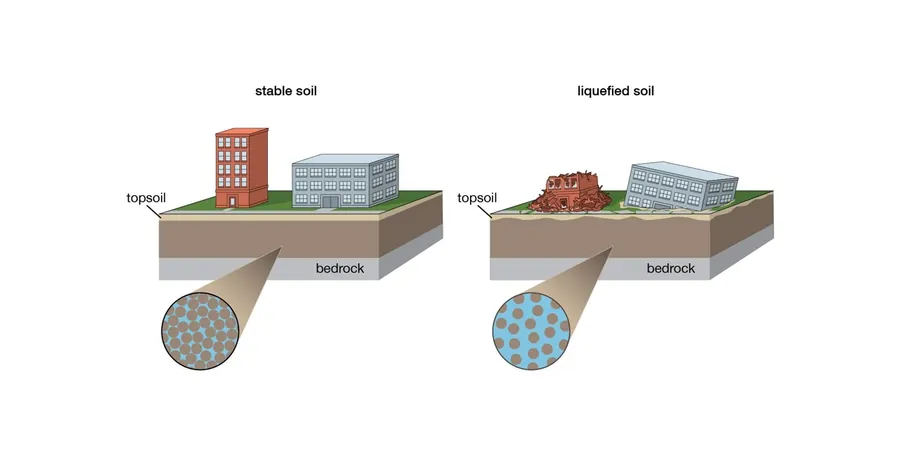
A common oversight in Gisborne construction is treating all flat coastal land as inherently stable, only to discover post-earthquake that saturated silts and sands behaved like a liquid under the foundation. The Poverty Bay flats, where the city sits near the confluence of the Waimata and Taruheru rivers, conceal layers of Holocene alluvium that are highly susceptible to cyclic mobility. Our soil liquefaction analysis cuts through that assumption with site-specific data, quantifying the factor of safety against triggering and the expected vertical settlement your structure could experience. We combine deep local knowledge of the Gisborne sediment sequence with advanced field testing to deliver a clear, defensible assessment that aligns with the NZGS Module 4 framework for liquefaction evaluation.
A site in Gisborne with a calculated LSN (Liquefaction Severity Number) above 2.0 demands ground improvement or foundation redesign—there is no middle ground with liquefiable soils.
Technical details of the service in Gisborne
Demonstration video
Local geotechnical conditions in Gisborne
The CPT rig we deploy in Gisborne is a 20-tonne tracked unit that pushes a 15 cm² cone at a constant 2 cm/s, recording tip resistance, sleeve friction, and pore pressure every 10 mm. This level of resolution is non-negotiable when mapping thin, loose sand seams that can cause a bearing failure even if the average profile looks competent. In the Whataupoko hills, where cut-and-fill terraces transition rapidly into natural slopes, we often supplement the CPT with dynamic pore pressure dissipation tests to understand how quickly the soil can drain excess pressure during shaking. Skipping this step in Gisborne’s layered geology is a gamble that no structural engineer should take, especially given the city’s proximity to the Hikurangi subduction zone, which generates events with strong long-period energy that are particularly damaging to saturated, loose deposits.
Our services
The scope of a liquefaction study in Gisborne is tailored to the project’s importance level (IL) as defined by the Building Code, but we consistently deliver a set of core analyses that cover the full ground performance spectrum:
CPT-Based Triggering and Settlement Analysis
We execute and interpret seismic cone penetration testing to derive the Cyclic Resistance Ratio and compute the reconsolidation settlement for each susceptible layer, producing a map of total and differential ground distortion.
LSN and Liquefaction-Induced Damage Classification
Using the NZGS-recommended Liquefaction Severity Number framework, we categorize the site from ‘minor’ to ‘severe’ damage potential, directly informing the need for ground improvement or foundation strengthening.
Lateral Spreading Hazard Quantification
For sites within 500 m of the Taruheru River or the coastline, we apply empirical displacement models to estimate horizontal ground movement, a critical input for deep foundation and retaining wall design.
Frequently asked questions
What triggers a mandatory liquefaction assessment for a building consent in Gisborne?
Under the Building Code clause B1, any structure classified as Importance Level 2 or higher on a site with a shallow groundwater table (within 4 m depth) and soils mapped as liquefiable by the GDC’s district plan typically requires a site-specific analysis. The presence of loose sands or silts in a borehole log to 10 m depth is a common trigger.
How do you differentiate between global and localised liquefaction risk on a single Gisborne property?
We run the CPT data through the soil behavior type index (Ic) to isolate truly contractive layers from dilative sands. A global risk means the entire bearing stratum can liquefy, while localised risk points to thin, discontinuous lenses—the latter may be mitigated with targeted ground improvement rather than a full deep foundation.
What is the typical cost range for a full liquefaction study in Gisborne?
A comprehensive study, including mobilisation, CPT soundings, data reduction, and a signed engineering report, generally falls between NZ$4,420 and NZ$6,920. The final figure depends on the number of soundings and whether pore pressure dissipation tests are required. More info.