Site investigation in Gisborne must address the region’s distinctive geology, from young alluvial plains and Poverty Bay marine sediments to erosion-prone hill country formed by weak Tertiary mudstones. Local compliance with NZS 4402 and the New Zealand Building Code requires targeted ground assessment to manage liquefaction susceptibility and slope instability. Deploying CPT testing delivers continuous subsurface profiles ideal for identifying soft layers and assessing soil behaviour in these variable coastal formations.
Residential subdivisions on hill sites, commercial builds on reclaimed flats, and infrastructure across the Waipaoa floodplain all demand robust data before design. Integrating cone penetration testing with laboratory analysis refines foundation recommendations and earthworks specifications, reducing risk in a landscape shaped by active tectonics and high seasonal rainfall. This evidence-based approach supports efficient, code-compliant development across the Tairāwhiti region.
An anchor is only as reliable as the ground that grips it — bond stress in Gisborne mudstone drops sharply above 50 kPa confining pressure.
Technical details of the service in Gisborne
Local geotechnical conditions in Gisborne
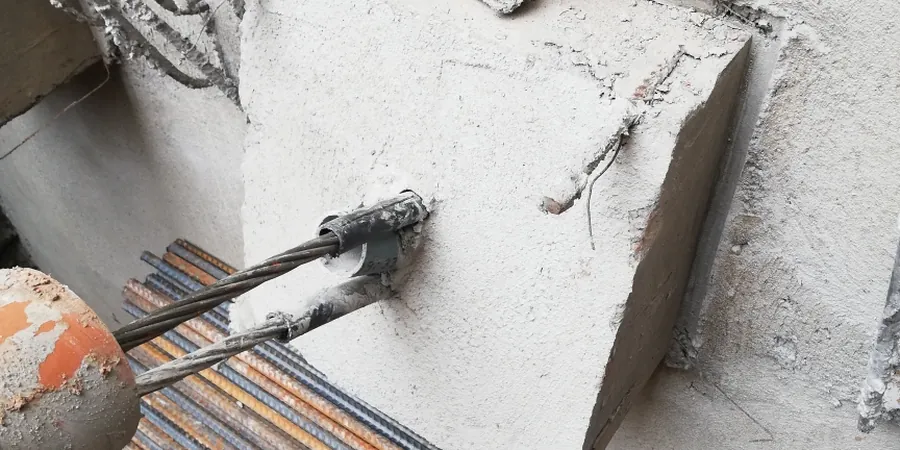
Gisborne’s exposure to heavy cyclonic rainfall — the city averages over 1000 mm annually — introduces a risk that dry-condition anchor designs ignore: pore-water pressure build-up behind retained faces. A passive nail system in a cutting off Lytton Road may perform perfectly during installation but lose 40% of its pull-out resistance once the ground saturates and effective stress drops. Active anchors face a different threat: long-term relaxation in the creeping mudstone of the East Coast Allochthon. We specify lock-off loads that account for this relaxation, typically 10–15% above the design working load. The proximity to the coast means chloride-induced corrosion is a real concern; double corrosion protection is mandatory for any anchor with a service life beyond 24 months within 500 metres of the shoreline.
Our services
Our anchor design package covers the full sequence from site investigation to commissioning. The four core services address the specific demands of Gisborne’s geology.
Active tieback design
Pre-stressed anchors for basement and retaining wall support in confined urban sites. We calculate bond length, tendon size, and lock-off load using site-specific soil parameters.
Passive soil nail systems
Non-stressed reinforcement for cut slopes and hillside developments. Design includes nail spacing, inclination, and facing connection details for the weathered profiles common in Gisborne.
Pull-out testing
On-site sacrificial and proof testing with hydraulic jacks and digital load cells. Load-extension curves are analyzed against the theoretical bond stress envelope.
Corrosion protection design
Sacrificial steel allowance calculation and DCP specification per BS 8081. We adapt the protection level to the exposure class measured on site.
Frequently asked questions
What’s the cost range for anchor design and testing in Gisborne?
Anchor design packages typically run from NZ$1 530 to NZ$6 300 depending on the number of anchors, the type (active vs. passive), and the testing requirements. A small retaining wall with four passive nails sits at the lower end; a multi-strand active tieback system with proof testing sits at the upper end.
How do you determine the bond length in Gisborne’s mudstone?
We use empirical bond stress values from the NZGS guidelines, calibrated with a sacrificial pull-out test on the first anchor installed. The test anchor is loaded to failure while we record load vs. extension, giving us a site-specific ultimate bond stress that replaces the preliminary estimate.
What’s the difference between a proof test and a suitability test?
A suitability test is performed on a sacrificial anchor and taken to failure to confirm the design bond stress. A proof test is done on every production anchor to verify it can hold the acceptance load (usually 1.5 times the working load for active anchors) without excessive creep.
Do you handle the drilling subcontractor coordination?
We work alongside your driller. Our team specifies the drilling method, hole diameter, grouting technique, and testing sequence. We don’t drill ourselves but we supervise the installation and conduct all load testing with our own calibrated equipment.